
 By
By 
The standard advice is to sit up straight, and it does not work. People correct themselves, hold the new position for about four minutes, drift back, and conclude they lack discipline. The problem is not that they are sitting badly. It is that they are sitting still. Postural back pain from prolonged sitting positions is fundamentally a problem of duration rather than alignment, and that changes what actually helps.
Static Load Is the Mechanism
Tissue tolerates load well and tolerates unchanging load poorly. Held in one position, spinal structures creep under sustained pressure, muscles maintain a low-level contraction without the pumping action that circulates blood, and the sensory system gradually amplifies its signal from a region that is not moving. This happens in a perfectly upright posture as readily as in a slumped one. The difference between the two is smaller than most people have been led to believe.
What Research Has and Has Not Found
The link between specific sitting postures and back pain is far weaker than the popular advice implies. Studies comparing people with and without back pain do not find a consistent postural signature, and interventions aimed purely at correcting alignment have modest results at best. What does correlate with symptoms is total sitting time without variation, physical conditioning, sleep, and psychological stress. This is worth knowing, because it redirects effort toward things that work.
The Most Effective Change Is Variation
The single most useful intervention is moving more often. Standing up every thirty to forty-five minutes, taking calls while walking, using stairs between floors, and changing seated position periodically all interrupt the sustained load. A sit-stand desk helps mainly because it makes switching easy, not because standing is inherently superior, and someone who stands rigidly for four hours will develop a different set of complaints. Variation is the active ingredient.
Setting Up the Workstation Sensibly
Basic arrangement still matters. Screen top roughly at eye level so the head is not held forward. Elbows near ninety degrees with shoulders relaxed and forearms supported. Feet flat with thighs approximately level, using a footrest if the desk height is fixed. Chair depth leaving a few fingers of clearance behind the knees, with lumbar support meeting the small of the back. This is a starting position to move away from and return to, not a posture to hold.
Laptops and Meeting Rooms
Two situations undo good setups. A laptop used directly on a desk forces either a bent neck or raised shoulders, and there is no arrangement that avoids both; a separate keyboard and a raised screen solve it for a few dollars. Meeting rooms are the other, since people spend hours in chairs designed for forty minutes. Standing at the back for part of a long meeting is more socially acceptable than most people assume and more useful than any amount of correction afterwards.
Where Manual Therapy Fits
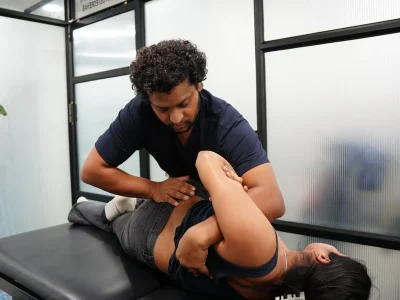
Hands-on treatment reduces pain and improves movement in the short term, which is genuinely useful when someone is stiff enough that starting an exercise programme feels impossible. Adjustment or mobilisation of restricted segments, soft tissue work through the hips and thoracic spine, and needling of trigger points all have a place. What none of them do is change the eight hours of static load that resumes tomorrow. Clinics providing chiropractic care for back pain should be clear about that division of labour.
Conditioning Does the Heavy Lifting
Tissue that is stronger and better conditioned tolerates sitting better. That means general physical activity, plus specific work for the hip and trunk musculature that supports the lumbar spine, and mobility work for the thoracic spine and hip flexors that shorten with prolonged sitting. Two or three sessions a week produces meaningful change over a couple of months. This is the intervention with the best evidence and the lowest compliance, for obvious reasons.
The Commute Counts as Sitting
People tally their desk hours and forget everything either side of them. An hour on the MRT or in traffic each way, a taxi between meetings, and an evening on the sofa can add three or four hours of static loading to a day that was already long, in seating that offers considerably less support than an office chair. Car seats in particular tend to place the hips lower than the knees, which is a demanding position for a lumbar spine to hold in traffic. Counting the real total usually explains why an otherwise sensible workstation has not solved anything.
Stress, Sleep and Pain Sensitivity
Sustained psychological stress raises resting muscle tone, particularly around the neck, shoulders and jaw, and it changes how pain is processed. Poor sleep lowers pain thresholds measurably. Someone working long hours under pressure and sleeping six hours will experience the same mechanical load as more painful than a well-rested colleague. Addressing these is not an alternative to physical treatment, but ignoring them explains a proportion of cases that do not respond as expected.
When It Is Not Just Posture
Get medical assessment rather than manual therapy if there is pain radiating below the knee with numbness or weakness, progressive neurological change, night pain unrelieved by rest, unexplained weight loss, fever, changes in bowel or bladder function, or a history of cancer. Absent those, postural back pain from prolonged sitting positions responds best to a combination of short-term hands-on relief, far more movement variation than feels necessary, and steady conditioning over weeks.










Comments